
Microsoft’s Agentic RAG Evolution
As organizations continue adopting AI, one challenge keeps surfacing: enterprise knowledge is fragmented.
Critical information lives across Azure Blob Storage, SharePoint, Microsoft 365, OneLake, internal databases, and even the public web. While traditional Retrieval-Augmented Generation (RAG) systems improved how AI models access context, they often struggle when questions require deeper reasoning across multiple sources.
Microsoft’s answer to this growing complexity is FoundryIQ.
FoundryIQ is not just another retrieval layer. It represents a shift toward Agentic RAG, where AI systems actively plan, reason, and orchestrate how knowledge is retrieved.
The Limits of Traditional RAG
Classic RAG pipelines usually follow a simple flow:
- Index documents
- Convert content into embeddings
- Retrieve the nearest matches
- Generate responses using retrieved context
This approach works well for straightforward questions.
However, real enterprise queries are rarely simple. Examples include:
- Comparing financial trends across multiple quarters
- Analyzing compliance rules across regions
- Correlating product documentation with external regulations
These scenarios require multi-step reasoning and cross-source intelligence, which traditional RAG was never designed to handle.
FoundryIQ: From Retrieval to Reasoning
FoundryIQ introduces a fundamentally smarter approach.
Instead of treating retrieval as a static step, FoundryIQ enables AI agents to reason about retrieval itself.
With FoundryIQ, agents can:
- Break complex questions into sub-queries
- Search across multiple connected knowledge sources
- Execute retrieval tasks in parallel
- Re-rank and synthesize results
- Produce coherent, context-aware responses
Retrieval becomes dynamic, adaptive, and agent-driven.
Key Capabilities of FoundryIQ
Unified Knowledge Layer
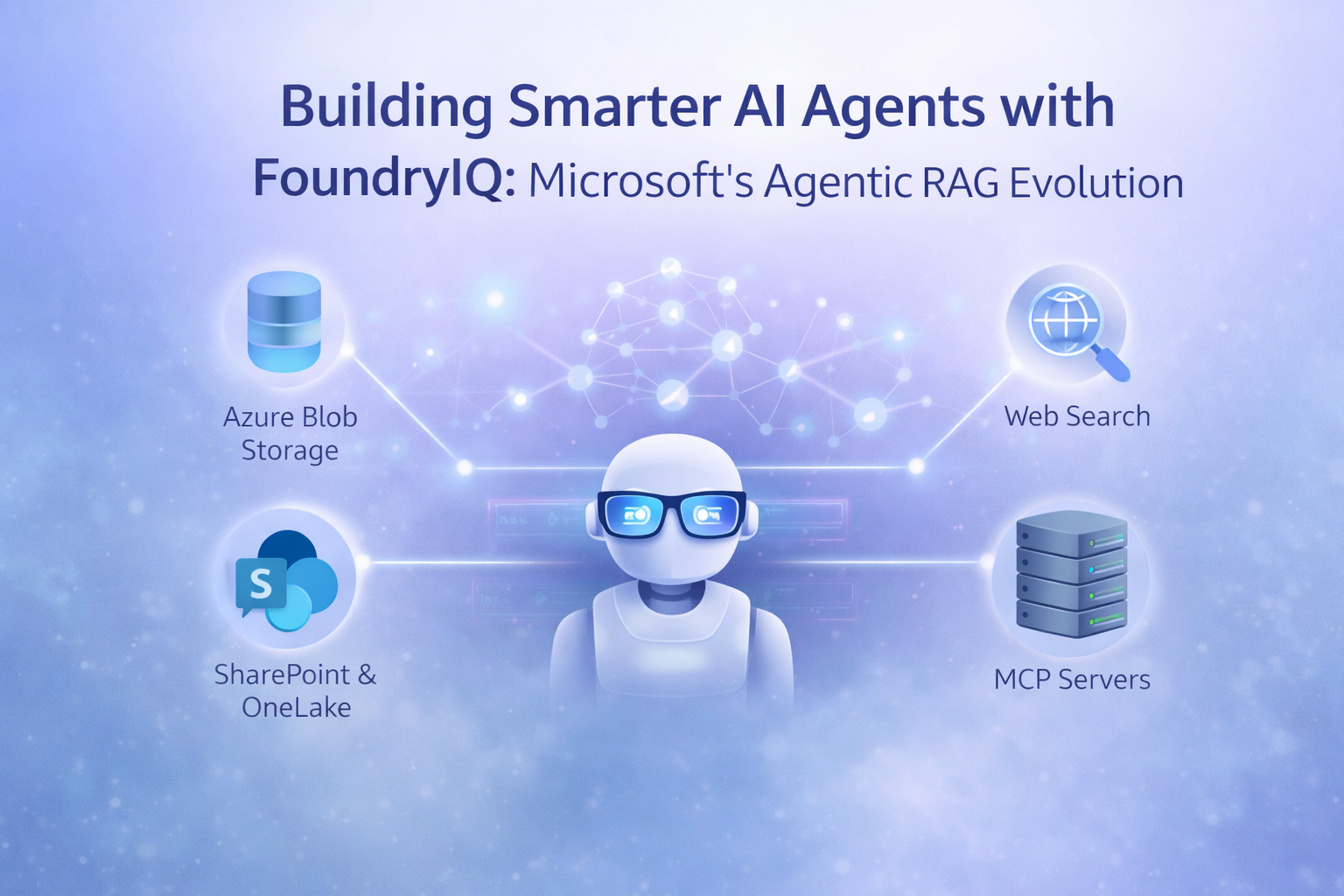
FoundryIQ allows multiple data systems to be connected into a single logical knowledge base, including:
- Azure AI Search indexes
- Azure Blob Storage
- SharePoint and Microsoft 365
- OneLake
- External web sources
- MCP-enabled services
This eliminates data silos and simplifies enterprise knowledge access.
Agentic Query Planning
Instead of blindly retrieving documents, FoundryIQ reasons about:
- What information is required
- Which sources are relevant
- How retrieval should be executed
This planning step dramatically improves relevance and answer quality.
Adjustable Reasoning Depth
Not every query requires deep reasoning.
FoundryIQ allows developers to tune retrieval effort:
- Fast, lightweight searches for simple queries
- Deep, multi-step reasoning for complex analytical questions
This balance ensures performance without sacrificing intelligence.
Improved Response Quality
By orchestrating retrieval intelligently, FoundryIQ delivers responses that better align with user intent, especially in complex enterprise scenarios where accuracy matters most.
How Agentic Retrieval Works
At its core, FoundryIQ leverages Azure AI Search’s agentic retrieval engine.
Behind the scenes, large language models help to:
- Analyze the user query
- Generate structured retrieval strategies
- Execute searches across connected sources
- Evaluate and re-rank results
- Synthesize a final grounded response
This process closely mirrors how humans research and reason about information.
Why FoundryIQ Matters for Enterprise AI
Modern AI systems are no longer evaluated solely on text generation quality.
They are judged by:
- Accuracy
- Contextual grounding
- Reasoning capability
- Cross-domain understanding
FoundryIQ directly addresses these challenges.
Instead of building complex retrieval orchestration logic from scratch, teams can rely on a managed knowledge intelligence layer and focus on delivering business value.
From Static AI to Intelligent Agents
FoundryIQ signals a broader shift in AI architecture:
From:
Retrieve documents → Generate answers
To:
Reason about knowledge → Plan retrieval → Synthesize insights
This evolution lays the foundation for truly intelligent, enterprise-ready AI agents.
Interested in Agentic AI and Azure architecture? Follow my blog for practical insights, hands-on experiments, and real-world Azure implementations.