
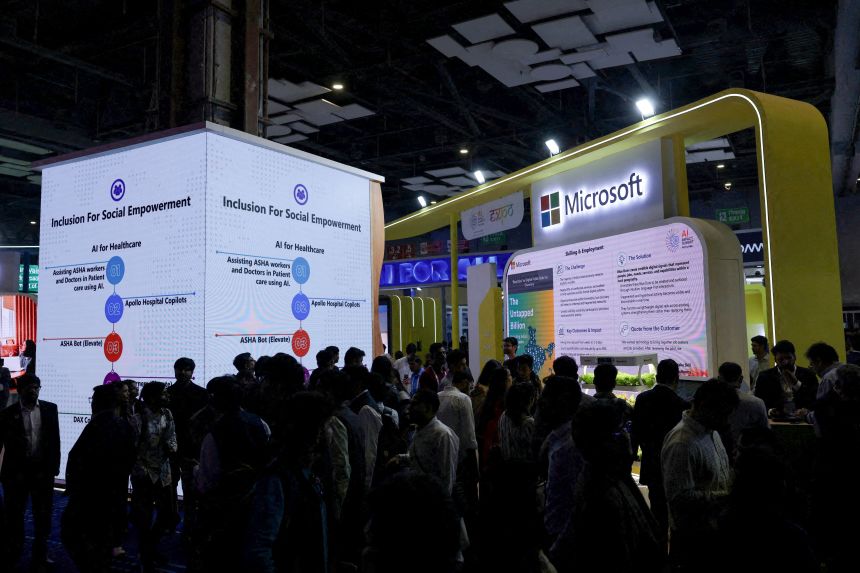
Microsoft 7 Predictions for 2026: A Story of AI Becoming Real
Imagine waking up in 2026 to a world where artificial intelligence isn’t just a tool it’s a true partner in your everyday life. Where machines don’t just answer questions, but collaborate with you, protect you, and push the boundaries of science, health, and technology.
This isn’t science fiction. This is Microsoft’s vision for 2026 a year the company believes will mark a turning point in how humanity and AI work together. Below, we unfold this future one chapter at a time.
1. AI Becomes Your Digital Teammate
In 2026, Microsoft expects AI to stop being just a tool that answers questions and start acting like a real colleague. Not in the futuristic robot sense, but as a digital assistant that collaborates with humans on creative and strategic tasks.
Picture a small team of three launching a global marketing campaign not struggling with data analysis and content creation, but letting AI handle most of the heavy lifting while the humans guide the strategy. Microsoft believes this will level the playing field for teams of all sizes.
Why this matters: AI will accelerate work in every industry, not replace people but amplify our capacities.
2. AI Security Switches from Optional to Essential
As AI becomes a digital co-worker, it’ll also become a potential security risk if not properly protected. Microsoft predicts that in 2026, AI agents will need stronger security safeguards, almost like granting them a “trusted identity” in systems.
A new era of AI cybersecurity will emerge, where AI systems are protected end-to-end and other AI tools will help fight off future cyber threats. In other words, AI will defend AI.
Why this matters: With more automation in business processes, protecting AI becomes protecting the heart of modern digital life.
3. AI Helps Shrink Global Health Inequality
One of the most inspiring predictions is that AI could help bridge major gaps in global healthcare. By 2026, Microsoft expects AI to go beyond diagnostics and help with treatment planning, symptom evaluation, and better access to care especially in regions where doctors are scarce.
This development could improve outcomes for millions of people from remote areas to fast-growing cities.
Why this matters: Health is a fundamental human need, and AI could help deliver smarter care more equitably.
4. AI Becomes a Scientific Research Partner
Here’s where the future feels almost like magic: Microsoft predicts that AI will no longer just summarize research papers or crunch numbers it will help generate hypotheses, design experiments, and even assist in running scientific experiments themselves.
This could accelerate discoveries in climate science, biology, physics, and more.
Why this matters: Scientists will work with AI systems, not just alongside them compressing years of exploration into shorter timelines.
5. AI Infrastructure Shifts Toward Efficiency First
Microsoft foresees a change in the backbone of AI: instead of building bigger and bigger data centers, the focus in 2026 will shift to smarter and more efficient computing networks.
These networks will dynamically allocate computing power to where it’s needed most, reducing waste and maximizing performance.
Why this matters: As demand for AI grows, efficiency helps reduce costs and environmental impact making the AI revolution more sustainable.
6. AI Understands the Meaning Behind Code
Developers write millions of lines of code every month. Yet today’s code tools often lack deeper understanding. By 2026, Microsoft predicts “repository intelligence” AI that not only reads code, but understands its purpose, history, and how parts fit together.
This means smarter suggestions, faster debugging, and more reliable software overall.
Why this matters: Software quality improves, teams move faster, and innovation accelerates.
7. Hybrid Quantum Computing Nears Maturity
Last on the list, but possibly most transformative, is quantum computing. Microsoft believes that 2026 will bring hybrid quantum systems where classical and quantum machines work together closer to real-world usefulness.
This doesn’t mean quantum will replace traditional computers yet but it will begin solving problems that were once thought impossible, especially in fields like materials science and medicine.
Why this matters: This could unlock breakthroughs far beyond what today’s supercomputers can achieve.
Conclusion: 2026 A Turn from Fiction to Reality
When Microsoft experts look ahead to 2026, they don’t see an AI that replaces humans. They see an AI that partners with us, protects us, and helps us solve the world’s toughest problems.
From healthcare to security, from coding to quantum computing, this predicted future promises real transformation not just hype.
Whether you’re a tech enthusiast, business leader, or curious reader, one thing is clear: 2026 could be the year AI finally becomes real not just revolutionary, but deeply human-centric.